
Oblique MPR in the main viewer (not only on the MPR viewer)
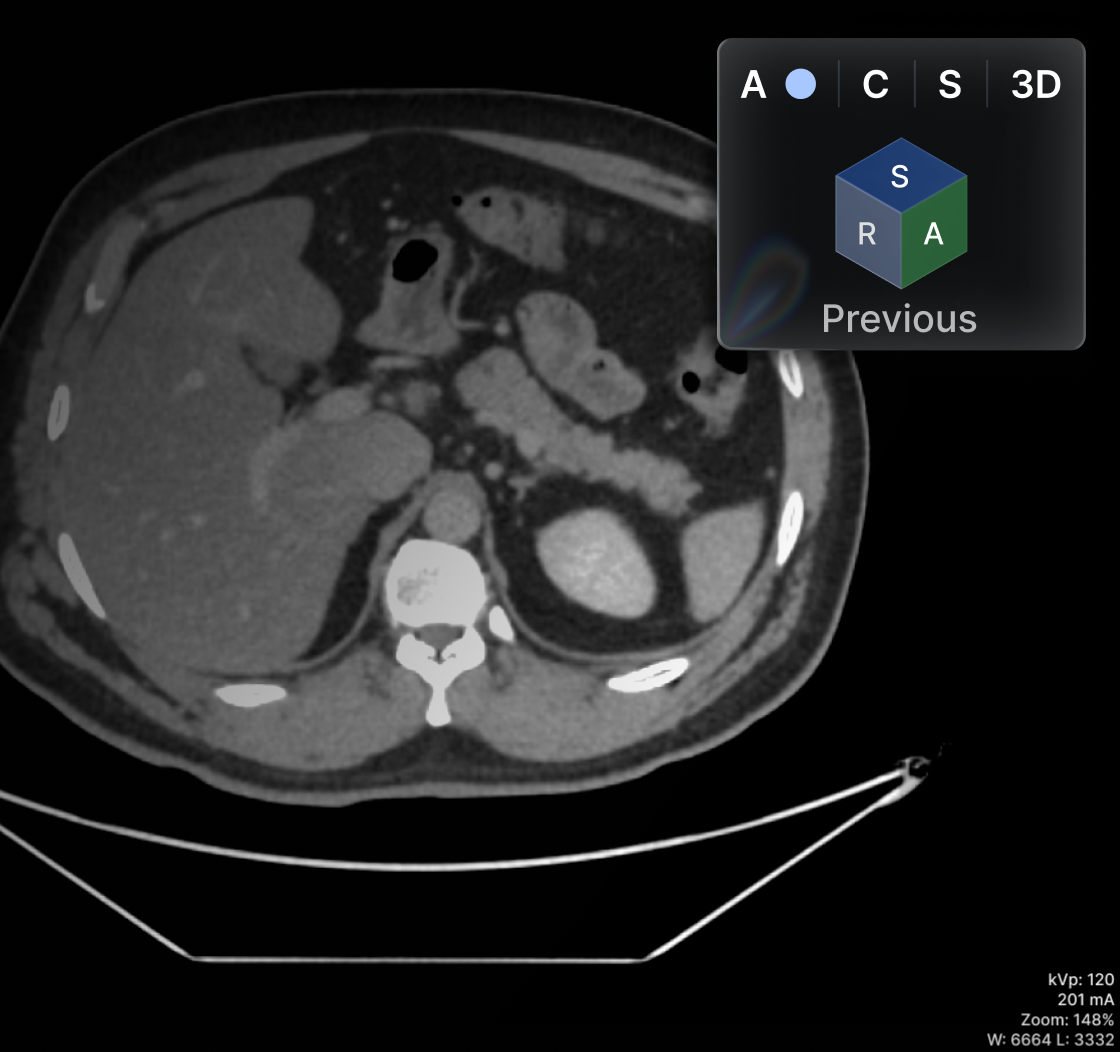
Standard orthogonal views depend on the scanner's acquisition geometry rather than the patient's actual anatomy. If a patient is misaligned (e.g., tilted head or rotated spine), standard views are effectively oblique. Oblique MPR lets radiologists adjust the reconstruction plane in real time to align with the true anatomy. This feature was available in the MPR viewer; now it is available in the main 2D viewer as well.
What it is
Oblique MPR is a multiplanar reformatting tool in the Eden PACS viewer that lets you reconstruct images along any arbitrary plane, instead of being restricted to the three orthogonal planes defined by the scanner geometry. It is controlled by an interactive orientation cube in the upper right corner of the viewport, which can be rotated freely around any of the three axes.
What it does
Standard MPR in the main viewer lets you switch between axial, sagittal and coronal views. These planes are derived from the acquisition geometry, so they are only true anatomic planes when the patient is well positioned in the gantry. If the head is tilted, the shoulders are rotated or the spine is not aligned with the table, every one of the three "orthogonal" views is in fact oblique with respect to the patient.
Oblique MPR removes that constraint. By dragging the orientation cube, the radiologist angles the reconstruction plane in real time until the anatomy itself defines the reference frame, recovering true axial, sagittal and coronal planes for that specific patient. Linked viewports follow the new orientation, and the view can be reset to the native acquisition geometry at any time.
Value and use in a clinical setting
Plane fidelity matters most where interpretation depends on symmetry, alignment or measurement. Typical examples include midline structures and ventricular symmetry on head CT and MRI, orbits, temporal bones and paranasal sinuses, vertebral endplates and disc spaces, joint surfaces, and any measurement of size, angle or distance that is only valid when made in a true plane.
For follow-up studies, it allows the reader to match the orientation of a prior exam so that measurements and comparisons are made on equivalent planes.
How it affects the physician workflow
The feature is available on demand and adds no steps to routine reading. When the patient is well positioned, the radiologist works exactly as before. When obliquity is detected, correction takes a few seconds directly in the viewport, replacing the alternatives of mentally compensating for the tilt, requesting a new acquisition, or accepting a measurement of uncertain validity.